Tuesday, February 7, 2012
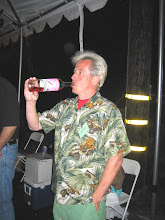
An objective evaluation of the new Pink Zeppelin.
Minions and bouncer agree, it's the best pink swill ever!

Friday, January 13, 2012
Is this a Pink Zeppelin? Sort of.

Ladies, gentlemen and fruit flies; friends, family, fans and stalkers, this is quite possibly the best pink wine I've made since the last one. How's that for hype?
One pallet of wine (56 cases) of Grenache, with minor amounts of Syrah, Mourvedre and Cinsault; most of the Grenache is from the Colossus of Rhones vineyard, which yielded less than one ton per acre. Fresh strawberries and cherries, bone dry, crisp acidity, lively palate that almost fizzes. I'd call this the perfect summer wine, but of course I'll be out of it - the wine, that is - long before it gets hot. So you should probably order it now, before it's bottled.
Oh wait, I haven't priced it yet!
Wednesday, January 4, 2012
Wine preservation systems.
What do I think of wine dispensing equipment that claims to preserve a partial bottle of wine for weeks? Slightly better than the risible pump vacuum stopper system, which removes one or two psi of pressure, leaving the other 85%+ of air inside the bottle. Pouring half a bottle of wine into a 375ml bottle immediately is plausible (though the bottle should be sparged with N2 first or better yet done inside a flushed cabinet) but this isn't what happens in the machines I see employed at wine bars.
One might as well open a bottle, pour it into ice cube trays, freeze the cubes, then microwave them individually when ordered. I'm sure some ass could invent the machine, and sell it to the credulous - of course, the biodynamic microwave costs extra.
One might as well open a bottle, pour it into ice cube trays, freeze the cubes, then microwave them individually when ordered. I'm sure some ass could invent the machine, and sell it to the credulous - of course, the biodynamic microwave costs extra.
Friday, December 16, 2011
A partial explanation of bottle shock.
A variable slight reduction in aroma and light to moderate reduction in flavor caused by reaction of molecular S with remaining O2 dissolved in wine that occurs after bottling, and can be ameliorated by lowering dissolved 02 in wine to under 1 ppm before bottling, not adding large amounts of SO2 immediately prior to bottling, and not filtering. It's generally observed between 10 and 30 days after bottling. Effects not fully understood as perception is mainly subjective; it allegedly affects Pinot Noir more than other wines.
I went to Berkeley, not Davis. Somebody check with a 'real' winemaker!
I went to Berkeley, not Davis. Somebody check with a 'real' winemaker!
Wednesday, December 7, 2011
NEW RELEASE: 2010 COLOSSUS SYRAH, PASO ROBLES
78% "Colossus of Rhones" aka Gill Vineyard.; 22% Secret Syrah (sorry)
17% alcohol by volume (yes, really). 111 cases bottled, $50/retail.
This clone 877 Syrah vineyard on the west side of Paso Robles was planted in 1998 and only yields 1-2 bottles per vine (aka tons/acre at 1,000 vines/acre). I instituted severe leaf thinning when I became the consultant last year, and delayed harvest until full flavor ripeness and seed lignification, which didn't occur until over 28 brix. Fear not, this is no flabby, sweet, baked raisin wine; the blackberry extract is fresh and extremely full and rich, and spices and oak emerge immediately, and the finish is very long without excess heat. Do NOT be ideo-enologically prejudiced against the high alcohol and youth; it shows fabulously and is at least my best red since the 2005 La Mort Du Roi (Elvis Died For Your Sins) "Hill of Graceland" Syrah. So far, opinions are rapturous from the handful of consumers, uber-winemakers, and unter-sommeliers that have tried it. But what do we know???
Sunday, November 6, 2011
Nobody's perfect.
Colossus of  Rhones, Gill Vineyard, West Paso.
4.1 acres clone 877 Syrah
Estimated yield 4 tons
Actual yield 3.9 tons
Target brix 28
Actual brix 28.0
(Indecent accuracy)
 Rhones, Gill Vineyard, West Paso.
4.1 acres clone 877 Syrah
Estimated yield 4 tons
Actual yield 3.9 tons
Target brix 28
Actual brix 28.0
(Indecent accuracy)
Friday, October 14, 2011
DEATH TO THE INFIDEL ZINFANDEL!

Actually, Petite Sirah, Syrah, and Zinfandel. With bacon.
This is wine club only, needless to say.
Subscribe to:
Posts (Atom)
Band practice