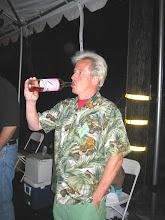
As most of you will know from getting my emails, the 2013 Verdejo is already in the bottle - it went from grape to glass in five weeks, and another three weeks have passed since then; local winemakers with more experience than I (and this is my thirtieth harvest in California) have pretended to be impressed - they might not be, if they knew how much wine I lost in hurrying it along. In the meantime, I've also picked Viognier, Tempranillo, Tannat, an utterly fantastic Pinot Noir, Zinfandel (two clones) and Vermentino; all but the last two have finished fermenting. The Zinfandel 'stuck' at a far higher sugar than I've ever experienced, about 5 brix, leaving me with three options: attempt a referment with nutrients and an allegedly stronger yeast, blend with another wine in such a ratio as to almost guarantee refermentation to dry, or make a port.
Of course I'll do all three - I have three barrels to play with, after all!
The Vermentino isn't finished because it was picked recently; it's foaming along very nicely, with some beautiful exotic aromas. In about five hours, the Syrah 877 pick starts at Gill Vineyard; this is the wine that has produced the Colossus. Because we grafted over some of the miscreant Grenache to Alicante Bouschet last year, with the right blend I can produce, bottle and label another 'La Mort Du Roi' aka Dead Elvis wine (elvisdiedforyoursins.com)- as long as nothing changes on the label except the alcohol and the vintage, it need not be resubmitted to the Feds. And there's no sense taking that chance that some bureaucrat will make sense of the label, if indeed it makes sense to anyone but me. For that matter, it seems that Verdejo is not an 'approved variety' for American wine, notwithstanding that I am the third producer in California (but the only coastal one) the other wineries/growers having legally called it White Table Wine on the label and claimed that Verdejo was a 'fanciful name'. As the Chateau d'Abalone label was approved as a varietal Verdejo last year, this means I can't change anything but the vintage and alcohol without exposing myself to a considerable delay, or worse; a shame, as I would like to vineyard designate (Twin Coyote Vineyard).
Friday, October 18, 2013
Thursday, September 19, 2013
Harvest in West Paso: the Colossus of Rhones at Gill.
The Syrah leaves turn color before the grapes are ready to pick. The sugar levels, and consequent alcohols, may seem very high, but the acid levels maintain into the high 20s and sometimes higher. Flavors are also not fully developed at 'normal' levels, and the seeds aren't lignified yet. A cool year like 2011 gave us wine with an alcohol of 16.5%, probably as low as we'll see absent the threat of another typhoon!
Already picked: Verdejo, Viognier, Zinfandel (Dusi and Primitivo clones), Tempranillo, and Tannat, as well as Grenache Blanc and Syrah, Mourvedre, and Grenache for pink.
Still to go: Vermentino, Pinot Noir, Counoise, Alicante Bouschet, Syrah, Petite Sirah, and a surprise or three. Most but not all of these are in West Paso.
Already picked: Verdejo, Viognier, Zinfandel (Dusi and Primitivo clones), Tempranillo, and Tannat, as well as Grenache Blanc and Syrah, Mourvedre, and Grenache for pink.
Still to go: Vermentino, Pinot Noir, Counoise, Alicante Bouschet, Syrah, Petite Sirah, and a surprise or three. Most but not all of these are in West Paso.
Wednesday, July 24, 2013
Mr. Natural Wine
Cartoonist Robert Crumb's best known character, Mr. Natural, was a cosmic con man, a spouter of acid-overdose aphorisms, a bearded pervert: perhaps the perfect spokesman for the latest wine trend to foam out the bunghole of a diseased barrel and cover the Internet. You've heard of organic wines, sulfite free wines, and biodynamic wines, so you're ready for "Natural" wine. Right?
To review: "Organic" wine regulations vary by nation, but generally mean no added sulfur in the winery. Because of this, the wines don't last long as a rule; while a small amount of added sulfur was allowed under the original definition, now the US limit is 10 parts per million, a fraction of what's in yogurt and dried fruit. "Biodynamic" means burying a cow horn full of magic crystals in the vineyard, and paying a license fee to a mercenary organization that follows the ravings of a dead Nazi lunatic.
"Natural wine" means all, some, or none of the above, but it does suggest that anyone making wine who doesn't use this term is making "unnatural" wine: Monsanto Merlot, not to be consumed by those not wearing a tinfoil hat.
Might I suggest as the next buzz term "Raw" wine, meaning wine that was never cooked - never left in a hot UPS truck for three hours, or in a warm kitchen for three days. Or it could mean grape juice, to which you are welcome to add pure, organic ethanol.
Whatever.
"Natural wine" means all, some, or none of the above, but it does suggest that anyone making wine who doesn't use this term is making "unnatural" wine: Monsanto Merlot, not to be consumed by those not wearing a tinfoil hat.
Might I suggest as the next buzz term "Raw" wine, meaning wine that was never cooked - never left in a hot UPS truck for three hours, or in a warm kitchen for three days. Or it could mean grape juice, to which you are welcome to add pure, organic ethanol.
Whatever.
Sunday, July 14, 2013
Tasting room closure
After almost two years, I've decided to close the Zeppelin Wine Hangar, which was officially the Red Zeppelin Winery tasting room, and unofficially the Stillman tasting room. I will be using a different venue for special wine tasting appointments, but I'm not disclosing the location unless contacted by an existing club member (a friend, family, fan or stalker) or someone vouched for by same.
Sunday, July 7, 2013
Out of the archives: a wine competition judging story from 1997.
AN INSUFFICIENTLY SHORT EXCERPT FROM A 1997 EDITION OF
MY PRE-WEBSITE NEWSLETTER, “THE THIEF”, ABOUT AN INCIDENT AT A WINE COMPETITION
This took place at one of the (then, it's fallen on hard times) larger wine competitions in America, the New World International, where the late Jerry Mead (although he was alive at the time) had made me chairman of the panel that rated the higher priced classes of Pinot Noir. Mastermind, counterpart, and cohort, we unanimously and independently selected an outstanding example of said varietal as the best of the most expensive wines, and picked an excellent wine as the best of the second-costliest class of Pinots. These wines were then forwarded to a “super-panel” made up of the three of us, the three-member panel that tasted the two classes of cheap Pinots, and some guy from Hawaii or somewhere that turned out to be a pervert. Our job: select the Number One Pinot Noir.
We tasted the four wines, and voted as follows: first place wine, one point; second place, two points; etc. Although the outstanding wine got four of seven first-place votes, it came in second, as one of the other panel’s judges voted it last place. This judge, who was from a European country not known for viticulture (and tulips make poor wine) argued that the outstanding wine was terrible, that it would not have been considered worthy of an award in any European wine competition, blah, blah, blah. He seemed to be rather excited. As a run-off vote would have given “our” wine (I was its loudest champion, of course) the prize, this person wanted to settle the matter based upon the initial vote.
We summoned the Chief Judge, who ruled in my favor on both wine and procedure despite the fact that the stubborn Dutchman was a buddy of his. The winning wine turned out to be the 1995 Fess Parker Pinot Noir, Reserve. Later, I asked the wooden-shoed judge if wine made from Pinot Noir didn’t deserve as much or more more stylistic leeway than other wines. I said, “Look at the variation in red Burgundy.” He said, “I hate Burgundy.”
Tuesday, June 4, 2013
One wine competition is not like the others . . .
The oldest major wine competition in California does not allow sommeliers, writers, chefs or other inferior types as judges - only winemakers. That said, some of these guys haven't tripped over a hose in a long time, and another judge on my panel, who boasted that he serves at ten different judgings, had never heard of dimethyl dicarbonate?!?! (I gave him a minute's worth of information, and he continued to draw a blank.)
Still, it's valuable and entertaining, and for two days I sat within ten feet of one of the best Central Coast Chardonnay and Pinot Noir producers, as well as the guy responsible for Two Buck Chuck. The judging format is different from most competitions in that there is no consensus or conference - you taste, write down a score and recommended medal, and move on.
Having judged there since 1990, I'm usually rewarded with some of the more obscure varietals, see above.
Still, it's valuable and entertaining, and for two days I sat within ten feet of one of the best Central Coast Chardonnay and Pinot Noir producers, as well as the guy responsible for Two Buck Chuck. The judging format is different from most competitions in that there is no consensus or conference - you taste, write down a score and recommended medal, and move on.
Having judged there since 1990, I'm usually rewarded with some of the more obscure varietals, see above.
Thursday, May 9, 2013
Elvis' Pharmacy
Almost everyone who reads this blog either gets my emailed enological spam, or reads 1-10% of my Facebook posts, which fall into 666 simple categories. So I try to write posts on my blog that are perhaps of more lasting importance than the ephemera I broadcast in those see-em-and-ignore-em manners.
This isn't one of those posts.
THE PARTY IS ONLY ELEVEN DAYS AWAY? WHAT ARE YOU WAITING FOR?
Oh yeah, my private jet to pick you up, and the Zeppelin guest house to say in. Maybe next year?
That oversaid:
Subscribe to:
Posts (Atom)